
Resistivity and conductivity of copper: table of values and industrial applications
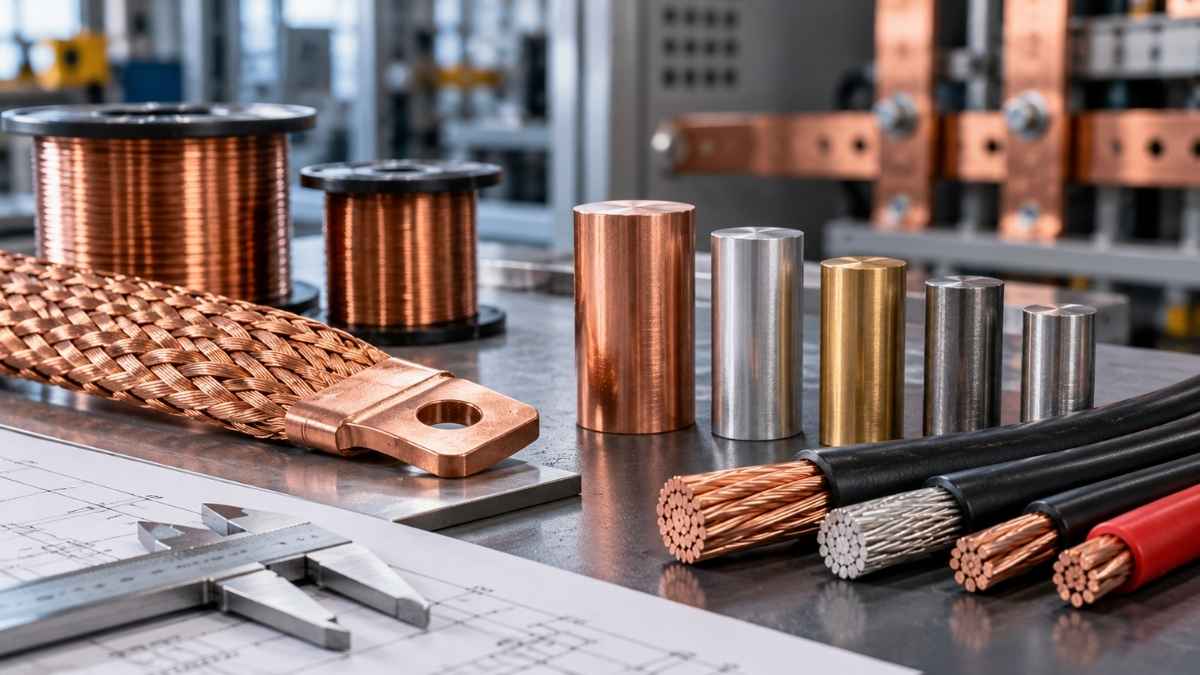
At first glance, a Litz wire and a conventional stranded cable look the same — dozens or hundreds of fine copper wires grouped together into a single conductor. The difference lies in a detail that cannot be seen and that changes everything: how those wires are grouped and how they are insulated from one another. That detail marks the boundary between a conductor that works well at 50 Hz and one that works well at 500 kHz.
What is a conventional stranded cable
A conventional stranded cable consists of several copper wires — normally bare or tinned C1100 — arranged in a helical geometry and in electrical contact with one another. The individual wires are not insulated: current can pass freely from one to another.
This construction has two advantages over a solid conductor of the same cross-section: greater mechanical flexibility (it withstands repeated bending without fatigue) and better vibration performance. It is the standard construction used in flexible copper braids and flexible and extra-flexible cables.
What is Litz wire
Litz wire — from the German Litzendraht, literally “stranded wire” — is also a group of fine stranded copper wires, but with two fundamental differences:
- Each individual wire is electrically insulated with a polymer enamel (polyurethane, polyester-imide, polyamide-imide) of micrometric thickness.
- The stranding geometry is calculated so that each wire occupies all possible positions (inner and outer) in a balanced way along the length of the conductor.
The result is that the current is distributed evenly among all the wires, instead of concentrating on the surface of the conductor. This only matters at high frequency — and that is the key.
Why Litz wire exists: skin effect and proximity effect
In direct current, current is distributed uniformly throughout the entire cross-section of a conductor. In alternating current, it is not. As frequency increases, current tends to flow along the outer surface of the conductor and avoid the centre. This is known as the skin effect.
The penetration depth of current in copper at 20 °C follows this approximate rule:
| Frequency | Skin depth (δ) |
|---|---|
| 50 Hz | 9.3 mm |
| 1 kHz | 2.1 mm |
| 10 kHz | 0.66 mm |
| 100 kHz | 0.21 mm |
| 1 MHz | 0.066 mm |
At 50 Hz, a solid conductor with a radius of 6 mm is fully utilised. At 100 kHz, however, the current only uses the outer 0.2 mm — the rest of the copper is dead weight that increases losses and heating.
The proximity effect worsens the problem in parallel conductors or windings: the magnetic field of one conductor pushes the current in the neighbouring conductor towards a specific area of its cross-section, further increasing the effective AC resistance.
Litz wire solves both effects at their source. Because each wire is insulated and passes through all positions in the bundle, no wire remains permanently in the centre (where no current would flow) or permanently on the outside (where it would become saturated). The effective cross-section is practically the total cross-section.
Technical comparison: Litz vs stranded cable
| Parameter | Conventional stranded cable | Litz wire |
|---|---|---|
| Insulation between wires | No (free electrical contact) | Yes (individual enamel) |
| Optimal frequency range | DC – 1 kHz | 1 kHz – 5 MHz |
| AC resistance at high frequency | High (skin effect) | Low (uniform) |
| Mechanical flexibility | Very high | High |
| Cost per metre | Standard | 3–8× higher |
| Termination types | Soldering, crimping, fusion | Requires prior enamel removal |
| Typical applications | Power, grounding, flexible connections | Induction, wireless chargers, HF transformers |
When to use conventional stranded cable
- Grounding and equipotential connections
- Flexible connections in electrical cabinets and busbars
- Compensation for thermal expansion in conductive busbars
- Power supply for 50/60 Hz motors
- Any DC application, including energy storage and photovoltaics on the module DC side
Rule of thumb: below 1 kHz, Litz wire does not provide enough advantages to justify its additional cost.
When to use Litz wire
- Industrial induction heating (metal melting, heat treatment, induction sealing)
- Inductive chargers for electric vehicles and wireless devices
- High-frequency transformers in DC-DC converters, switching power supplies, SMPS
- High-speed motor windings with high-frequency PWM drivers
- RF applications in the mid-kHz range
- Resonant traps and high-Q filters
At Masfarné, we manufacture custom Litz wires with different combinations of wire count, gauge and enamel type according to the operating frequency and allowable losses.
How to size a Litz wire
A Litz wire is not specified solely by its total cross-section, as a normal conductor is. Three parameters are required:
- Individual wire diameter (AWG gauge or mm). It must be less than twice the skin depth at the operating frequency. At 100 kHz, the skin depth is 0.21 mm, so the wire should have a maximum diameter of 0.4 mm — typically wires from 0.1 to 0.2 mm are used.
- Number of wires. It is calculated from the required total cross-section and the selected gauge.
- Enamel type and thermal class. Polyurethane (155 °C, directly solderable), polyester-imide (180 °C) or polyamide-imide (200 °C) depending on the operating temperature.
It is also advisable to specify whether the Litz wire should have an outer silk or cotton covering, polyester textile or an additional coating depending on the application.
Frequently asked questions
At what frequency does a standard stranded cable stop being cost-effective?
It depends on the gauge of the individual wire. As an operating rule, above 5–10 kHz the skin effect begins to become noticeable, and above 20 kHz Litz wire is usually economically justifiable if losses are a design factor.
Can I solder Litz wire directly?
If the enamel is polyurethane (“solderable”), yes — molten solder at high temperature removes it. With higher thermal-class enamels, it must first be removed mechanically or chemically.
Is Litz wire suitable for 50 Hz?
It works, but it provides no advantage over a conventional stranded cable at that frequency and costs several times more. It is not the correct option unless there is a very specific requirement.
How many wires does a typical Litz wire have?
It varies enormously depending on the application: from 30–50 wires in a simple Litz wire to several thousand in “servo Litz” constructions with a concentric group structure.
Conclusion and next step
The choice between Litz wire and conventional stranded cable comes down to two things: the operating frequency and the allowable AC losses. Below 1 kHz, almost always a stranded cable. Above 10 kHz, almost always Litz wire. In between, the calculations need to be done.
Do you have a high-frequency application and want to validate the construction? Consult our technical team


